



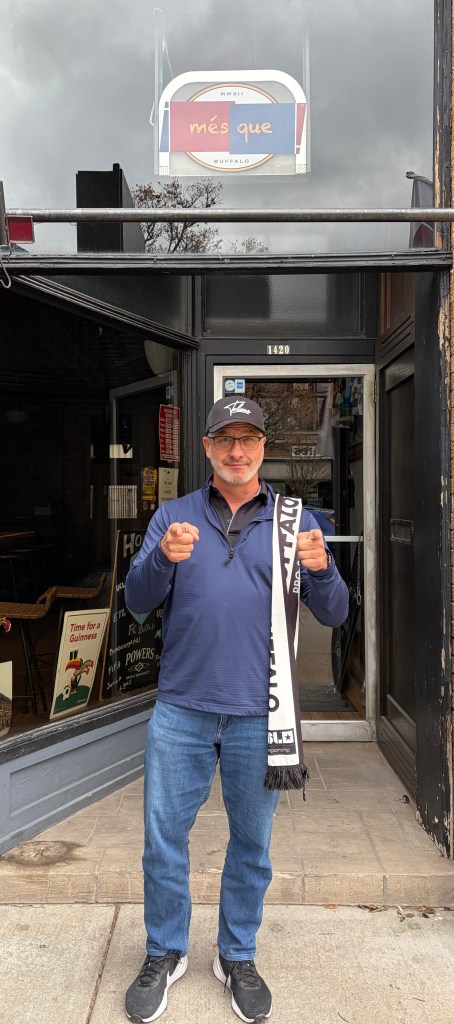
Tony Christiano Jr. has played and coached soccer in Buffalo for decades and is now an assistant coach at St. Joe’s, where he started coaching in the mid-90s. His son Leo left home at 12 for the Sporting Kansas City academy and now plays professionally in Huntsville, and off the field Tony is the President of Hertel Plumbing and Heating and one of the owners of Més Que.
Tell us about your soccer background in Buffalo.
“I played everything as a kid, because we all did, and then I got into college and ended up playing at Canisius for a while. After that I coached a year or two at Niagara County Community College as an assistant, and in the mid-90s I coached the JV team at St. Joe’s with Dan Donvin, who coached the varsity.
When I started having kids, I stepped away for a few years and stopped playing because it became too painful [due to age]. Around the time I turned 40, I started playing again and reconnected with a lot of guys I had played with in the past. I started coaching at Delaware Soccer Club and helped run it, then got involved with Global Premier Soccer, spent a year at Rush, and got hooked up with the Flash Academy, where I’ve been assisting. Now I’m also an assistant coach at St. Joe’s, back where I started, so it’s come full circle.”
Have you only coached boys, or have you worked with girls too?
“It’s mostly always been boys, but at Delaware I helped out on the girls’ side and with coed teams on the youth side. I always followed the path my kids were on and helped out along the way.”
What changes have you seen in the game over those years?
“The good thing is that since Jürgen Klinsmann came in, he helped develop a model the country has followed, with a heavy focus on academies and development from grassroots all the way up. It created a pyramid, and that has been good.
The bad is still the politics and infighting between towns, and looking at what’s in the best interest of the club instead of the player. In my opinion, it needs to go the other way around, because the better the players we get out, the better it is for the bigger picture.
There is also too much emphasis on wins and losses from ages 5 to 15 in this country. Until 14 or 15, it should be heavily focused on development and knowing how to pass and receive, and it’s amazing to me that players at all levels in this country still have difficulty doing the simple things.”
How do you coach with a development focus when wins and losses still matter?
“My approach is a heavy focus on the simple things: body shape, what foot to receive on, weight of the ball, and understanding space and time, and I don’t care about moves.
For me, the game always boils down to the fundamentals, especially in high-pressure moments. When the stakes are higher, it comes down to the DNA, everything that was built in at an early age. How do you receive a ball, how do you play it, and do you have your head up and understand the time and space around you? Johan Cruyff is quoted as saying, ‘Soccer is a simple game, but it’s hard to play simple.'”
Leo left Buffalo at 12. How was that transition for your family?
“It was super hard, and my wife and I still talk about whether we did the right thing. But his growth as a person has been remarkable, and he’s really mature. He’s been home for the last two months, and he jokes with my wife that she needs to make him dinner because she abandoned him for six years. She looks at him like she wants to cry, but we know he’s kidding.
With FaceTime and the ability to travel, we flew out about once a month, and we made sure he was always around good families. He was really raised by the academy at Sporting Kansas City, which turned him into a young man, and I have nothing but tremendous respect and gratitude for those people.”
What did Buffalo not provide for Leo at the time?
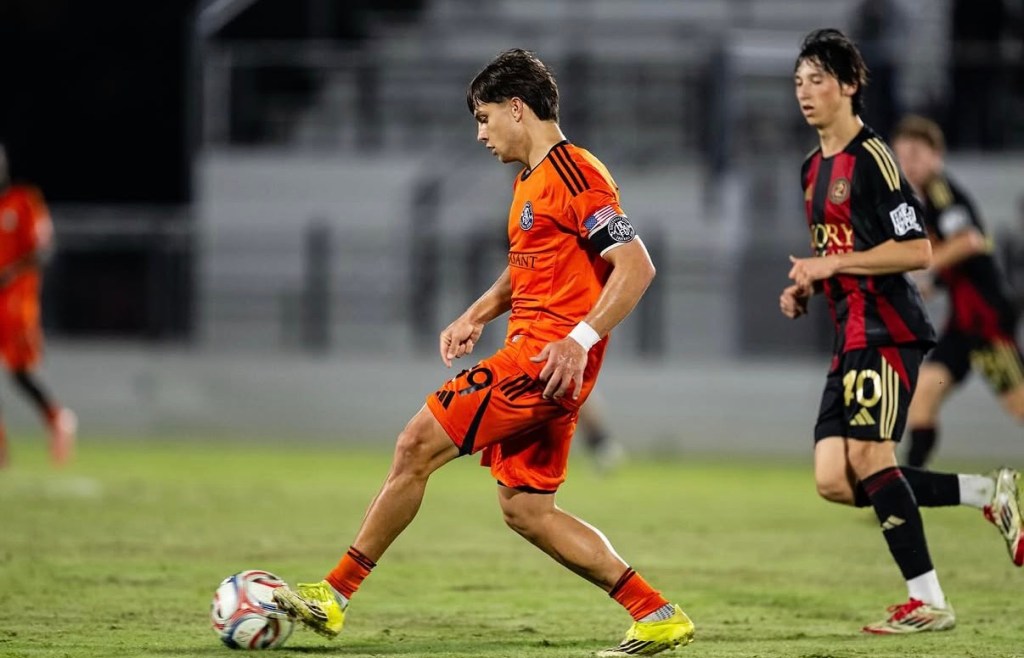
“We didn’t make this decision alone as a family. I reached out to a lot of people, including former professionals and coaches at high levels. Leo had been training with Bayern Munich and with clubs in Spain and Holland, and he was always in the national team pools. Pretty much every one of them said he was at the level, but he didn’t have a European passport, so there was nothing they could do.
He went out to Kansas City at 11, and they offered him a spot, but my wife said he wasn’t going because he was 11. He went back the next year, and they offered him again. I told my wife that if we weren’t going to have this conversation, then what were we doing going to Germany, Holland, and Spain? The second time, the U-13 coach pulled him into the office and asked how he’d like to be there, and Leo looked him in the eye at age 12 and said, ‘I need to be here.’ I thought, who is this kid?
My wife’s family lived out there, so he stayed with them for the first part. When COVID hit, they were in their 60s and couldn’t keep up with driving to trainings and school, so he ended up staying with the Molinaro family, who are some of the greatest people I’ve ever met. They looked after him for six years, and they’re crazy Italians, but we’re just as crazy.”
How did Leo end up in Huntsville?
“After Kansas City, he went on trial with New Mexico for a week or two. He picked up a small injury there, so he came home while they were on the road and didn’t sign. While he was home, he got calls from two or three other organizations, and then his former coach, Chris O’Neill, who was at Nashville and now coaches the second team in Huntsville, reached out to see what he was doing. Leo always had so much respect for Chris, and that’s why he went there, because it was nice to have a familiar face going into the unknown.”
What was it like to see Leo play pro for the first time?
“He had been playing at that level since he was 16, and his first professional contract was with Nashville, which assigned him to Huntsville. It’s awesome. It’s a great environment and a great club with a ton of deep talent, where every day guys are fighting for their lives to stay in the lineup and get minutes, and he really loves it.
Huntsville, Alabama, is also a surprisingly cool place and one of the fastest-growing cities in the United States. I really enjoy going down there, which I never thought I’d say. My wife and I catch a lot more games than we did when he was in Kansas City, because he’s on the East Coast now and the West Coast travel was a lot more grueling.”
How can Buffalo do a better job of developing young talent so players don’t have to leave?
“The reason Leo left was that there wasn’t a platform at the time where he could compete and grow, so he needed to be in a bigger pond with stronger fish. It’s the same with hockey, because you want to be around the best players all the time. Patrick Kane left when he was 14 years old because he had to get into a stronger pond to develop, and you only get better around better players.
So how does that work here? I think you need a concentration of the best players in the region in one location, not three good players here, two there, five up north, and six down south. You need the 20 or 30 best players right here, and every day should be a fight for your life, because that’s how you get good.”
What advice would you give families whose kid wants to go pro?
“Take all the weight of it into consideration, and remember that it’s not the parents’ decision, it’s the kid’s decision, so respect their wishes. I’ve seen phenomenal players who never wanted to leave home, and that’s okay. If a kid leaves home and is uncomfortable and didn’t want to go, they’ll be sent home pretty quickly, because there has to be a desire from the player. The flip side is the kids who really want to go, get there, and just aren’t good enough, and that’s okay too, because it’s part of the journey. The line I use to wash it all away is that no matter what level you played at, all roads lead to the bar league.
Whatever journey you’re on, enjoy it, because it goes really quick. My youngest, Fabio, is a sophomore at St. Joe’s, and I can’t believe it. A friend of mine said something about hockey that works for every sport: it’s hard to make a kid love the game, but it’s easy to make them hate it.
When I coach 10- or 12-year-olds, parents ask me if their kid is good, if he’ll be D1, or if he can go pro or get into an academy, and I look at them and say, ‘I don’t care.’ They think I don’t care about their kid, but that’s not it. My vision of success as a parent and as a coach will be sitting on the sideline in a lawn chair with a cup of coffee, watching my kids coach their kids. That means I’ve created culture, and that’s more important than any result in any game.”
What has it been like with soccer fans at Més Que?
“The World Cup was packed, and I told my office I’d see them in a month. We’d go to work in the morning and come over for the games, and it’s been like that since we opened.
My cousin Mike, our partner Howard, and I used to go to Europe every year, and the first time was Barcelona in 2006. A Bills game is cool, but catch a Clásico between Barcelona and Real Madrid and you feel the politics and passion behind it. That’s where our name comes from. During the Franco era, the stadium was the only place men could gather and talk politics, so they held their meetings at halftime and during games, and the club’s president said they were ‘més que un club,’ more than a club.”
What’s your favorite memory from Més Que?
“There are a lot, but my favorite is when we first opened and I walked in for a World Cup game. By the time I got from the front to the stage in the back, maybe 30 or 40 feet, I’d heard five different languages, so we call it the soccer U.N. During the big games, you’ll have Croatian, Nigerian, Irish, and English fans all in the same place.
A player I used to coach is from Manchester, and he brought his mother in on Boxing Day. We had five TVs going with all the games, and she said you could never do this back home because they’d kill each other.”